Is Brainwave Synchronization Real?
If you have ever listened to an entrainment track and felt your mind “click” into a steadier rhythm, you are asking the right question: is brainwave synchronization real or is it a pleasant illusion?
The most honest answer is this: yes, brainwave synchronization is real as a measurable phenomenon, but most marketing language around it is sloppy. What is real is the brain’s tendency to respond to repeated sensory patterns, especially rhythmic sound. What is often exaggerated is the idea that a single track can force the entire brain into one perfect frequency as if the nervous system were a metronome.
To understand what is real, what is limited, and what NeuralSync™ does differently, we need to define what people mean by “synchronization” in the first place.
What People Mean by “Brainwave Synchronization”
The phrase is used in three different ways, often mixed together.
1) Frequency following response (FFR)
This is the basic idea: when the brain is presented with a steady rhythmic stimulus, neural activity tends to show increased responsiveness at that rhythm. This is not mystical. It is how nervous systems detect pattern, timing and repetition.
2) Entrainment
Entrainment is a stronger claim than “response.” It implies that brain activity begins to align more consistently with a targeted rhythm, not just notice it. This can happen to a degree, but it is not an on/off switch. It is also not uniform across the brain.
3) Coherence
Many people say “synchronization” when they really mean coherence, meaning different regions of the brain communicate with more consistent timing. This matters because coherence is tied to attention, learning, meditation depth and state stability. But coherence is not the same thing as “all brainwaves become identical.”
When someone asks “Is brainwave synchronization real?” they usually want to know whether audio can create meaningful state changes beyond placebo. The accurate framing is: audio can influence brain state tendencies, especially when it is engineered to drive stable rhythmic signaling, reduce competing noise and support sustained attention. The effects vary by person, by session, by nervous system load and by how the audio is built.
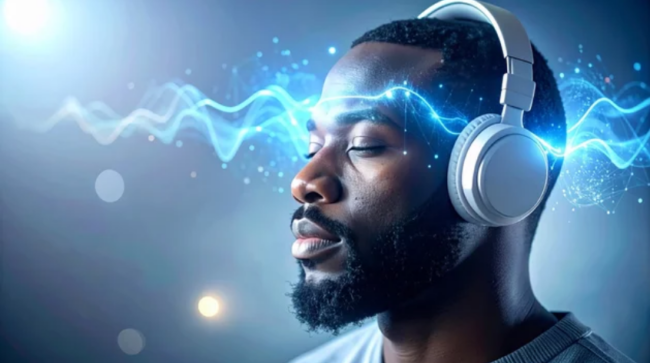
The Reality Check Most People Skip
Your brain is not a single oscillator. It is a living network that runs multiple rhythms at once. Even when you are relaxed, you can have:
-
slower rhythms prominent in some networks
-
faster activity in others
-
shifting dominance depending on attention, emotion, fatigue, and environment
So if someone promises “we synchronize your brain to 7.83 Hz” as though that is the whole story, that is more slogan than science.
What is real is this: the brain can lock onto rhythmic cues, and over time those cues can bias the brain toward certain state characteristics. That bias can be subtle or strong depending on the design and the listener.
Why Audio Can Influence Brain States at All
Sound is one of the most direct pattern inputs the brain receives. Your auditory system is built for timing precision because timing is survival-critical: footsteps, speech, distance, threat detection. The brain does not treat rhythmic sound as background. It treats it as information.
When audio contains stable rhythmic structure, the nervous system can mirror that structure in its own timing. That is the foundation that makes entrainment plausible.
But plausibility is not proof of quality. Two tracks can both claim “brainwave synchronization” while one is crude and one is carefully engineered.
Why Many Entrainment Tracks Disappoint
There are several common reasons people try “binaural beats” or “isochronic tones” and feel little change.
Single-layer design
A lot of entrainment audio is essentially one technique pushed hard. It is linear by construction. That can work for some people, but it can also feel thin, irritating or mentally noisy.
Compressed audio and harsh carriers
Many tracks are delivered as low-quality files, or they use aggressive tonal carriers that create listener fatigue. If the listener is fighting irritation, the nervous system does not settle. You can’t expect stable state-shifts while the sensory input is grating.
Overpromising
People are told to expect instant, dramatic results. The nervous system does not negotiate with hype. State change often looks like subtle stabilization, less internal chatter, faster settling, deeper stillness or improved consistency over time.
No architecture
Most “brainwave synchronization” products are not systems. They are tracks. A system has internal layering, timing logic and state-management. A track is just a sound file.
This is where NeuralSync™ takes a different approach.
What NeuralSync™ Means by Synchronization
NeuralSync™ does not treat “synchronization” as a single-frequency stunt. It is built around a whole-brain synchronization goal, meaning state stabilization across the nervous system using a multi-layer architecture rather than one entrainment trick.
NeuralSync™ core system elements include:
-
4-W.T.S.P.™ (4-Wave Tonal Synchronization Process) for quadruple-frequency entrainment and synergistic layering
-
Hololiminal™ subliminal architecture integrated into the listening experience as part of the system design
-
Zero-point energetic scalar wave augmentation as an additional layer aimed at lasting support beyond the session experience
-
Dimensional, lossless digital audio with immersive 3D nature soundscapes designed for headphones
-
A broader ecosystem that also includes Rife frequency / MOR therapy recordings and Ho’oponopono integrated through morphic resonance principles
That ecosystem matters because it signals something most people miss: NeuralSync™ is built as an architecture of effects, not a single mechanism.
A key distinction: NeuralSync™ and MOR therapy
NeuralSync™ includes Rife frequency / MOR therapy recordings, but those are not the same thing as the core entrainment system. MOR therapy requires pure frequency delivery rather than the 4-W.T.S.P.™ layered entrainment approach. Scalar enhancement can still be included, but the architecture and intent differ.
That distinction is important because it shows design discipline. A real system does not force one method onto every use case.
What Makes Synchronization Feel “Real” to the Listener
People often judge reality by sensation: “I felt it, so it must be real” or “I didn’t feel it, so it must be fake.” Both are incomplete.
Some of the most meaningful state shifts are not dramatic. They can be:
-
a quicker drop into mental quiet
-
less resistance to stillness
-
a steadier attention field
-
a sense of internal order rather than mental scatter
-
easier transition into meditation depth
These are not proof that your entire cortex is now running a single frequency. They are signs that the nervous system is moving toward a more stable operating mode.
NeuralSync™ is engineered to support that kind of stability without relying on harsh stimulus. The use of lossless audio and dimensional soundscapes is not cosmetic. It is part of making the input tolerable enough for the brain to stay with it. If you cannot stay with it, you cannot entrain to it.
Is It Just Placebo?
Placebo is a real effect. But that does not make everything placebo. The better question is: does the method have a plausible mechanism plus repeatable outcomes for the listener?
With brainwave entrainment, mechanism plausibility exists because the brain responds to rhythmic stimulus. Repeatability depends on:
-
the person’s baseline stress load
-
the design quality of the audio
-
consistency of use
-
whether the audio causes fatigue or supports comfort
NeuralSync™ is built around repeatability. It is designed for daily use, commonly described as 60 minutes a day, because state training is usually more reliable than state chasing.
The Biggest Misunderstanding: “One Frequency Fixes Everything”
The internet is saturated with frequency claims: one number for sleep, one number for focus, one number for healing. Reality is more nuanced.
Brain states are not single frequencies. They are patterned relationships between rhythms. That is why NeuralSync™ uses a multi-dimensional, multi-layer approach rather than presenting “the” frequency as the answer. The system is designed to create conditions in which the brain can reorganize toward coherence and stability.
This is also why NeuralSync™ positions itself as fundamentally different from typical binaural beats or isochronic tones. Many products are built as single-method tools. NeuralSync™ is built as a layered framework with proprietary architecture.
What “Real” Looks Like in Practical Terms
So, is brainwave synchronization real?
It is real if you define it correctly:
-
Real as a measurable brain response to rhythmic stimulus
-
Real as a tendency toward greater state stability
-
Real as a meaningful subjective shift for many listeners
-
Not real as a simplistic promise that one frequency forces the entire brain into uniform lockstep
If you want the shortest truthful version: brainwave synchronization is real as influence, not as domination. The brain can be guided. It cannot be reduced to a single dial.
Why NeuralSync™ Matters in This Conversation
Most skepticism about “brainwave synchronization” is earned. People have heard inflated claims, tried low-quality tracks and concluded the entire category is hype.
NeuralSync™ is positioned as a different class of system because it emphasizes:
-
layered entrainment rather than a single trick
-
lossless architecture rather than compressed delivery
-
dimensional soundscapes that support sustained listening
-
Hololiminal™ subliminal design as part of the broader architecture
-
scalar augmentation as an added layer of support
-
a wider ecosystem that includes MOR therapy recordings and Ho’oponopono through morphic resonance principles
In other words, NeuralSync™ treats synchronization as a systems problem: state induction, state stabilization and long-run consistency.
That is the difference between a track that claims results and a framework that is engineered for them.
Final Answer
Yes, brainwave synchronization is real when understood as the brain’s capacity to respond to rhythmic input and shift toward more stable states. It becomes unreliable when people treat it like a magic frequency switch.
If you want “real” in a way you can actually use, look for an approach that respects the complexity of the nervous system, avoids listener fatigue and is built as a coherent architecture. That is the standard NeuralSync™ is designed to meet.
For a full definition of the system, see What Is NeuralSync™ Neuro-Frequency Technology
To experience NeuralSync™ for yourself, download the Introduction Sessions.