Brainwave Entrainment Explained
How NeuralSync™ Works with Brain States to Support Healing, Focus and Regulation
Brainwave entrainment is a neurological process, not a belief system and not a relaxation technique. It describes how the brain naturally synchronizes its electrical activity to rhythmic stimuli, a phenomenon observed in EEG research for decades.
NeuralSync™ Neuro-Frequency Technology applies brainwave entrainment deliberately and precisely, using engineered frequency structures to guide the brain into specific functional states associated with rest, focus, emotional regulation and recovery.
To understand what makes NeuralSync™ different, it’s essential to first understand how brainwave entrainment actually works.
What Brainwave Entrainment Is
The human brain operates through electrical signaling. Neurons communicate via electrical impulses that, when measured collectively, form rhythmic patterns known as brainwaves.
Brainwave entrainment occurs when the brain aligns its internal electrical rhythms with an external, repeating stimulus. This can happen through light, movement, sound or other rhythmic input. When the stimulus is stable and coherent, the brain tends to follow it.
This is not forced control. It is a natural synchronization response, similar to how circadian rhythms align with daylight or how breathing slows when exposed to calm, steady patterns.
In audio-based entrainment, precisely structured sound frequencies act as the stimulus that the brain responds to.
The Major Brainwave States and Their Functions
Brainwave entrainment works because different brainwave ranges are associated with different functional states.
Beta (approximately 13–30 Hz)
Associated with alertness, analytical thinking and problem-solving. Excessive beta activity is often correlated with stress, mental fatigue and nervous system overactivation.
Alpha (approximately 8–12 Hz)
Associated with relaxed awareness, calm focus and emotional balance. Alpha states are commonly linked to creativity, learning and nervous system regulation.
Theta (approximately 4–7 Hz)
Associated with deep relaxation, meditative states, emotional processing and memory integration. Theta is often involved in trauma resolution and subconscious patterning.
Delta (approximately 0.5–3 Hz)
Associated with deep restorative sleep and physical recovery. Delta states support bodily repair and nervous system reset.
Brainwave entrainment does not “create” these states. It supports the brain’s ability to access them more consistently and efficiently.
Brainwave Entrainment vs Frequency Healing
Although often conflated, brainwave entrainment and frequency healing are not the same mechanism.
Brainwave entrainment works at the level of neural timing. It focuses on synchronizing electrical activity in the brain to support functional states.
Frequency healing works at a broader systemic level, using frequencies associated with physiological processes, energetic coherence or MOR-based applications.
NeuralSync™ integrates both where appropriate, but they serve different roles. This page focuses specifically on how NeuralSync™ interfaces with the brain itself through entrainment.
For a detailed explanation of frequency-based healing principles, see the Frequency Healing guide in the Knowledge Library.
Why Most Brainwave Entrainment Programs Fall Short
Many brainwave entrainment products rely on simplified approaches such as single-frequency binaural beats or basic isochronic tones. These methods assume that presenting one dominant frequency is sufficient to guide complex brain activity.
In practice, the brain is not linear.
Real neural activity involves:
Multiple brain regions operating simultaneously
Constant shifts between states
Interhemispheric communication
Adaptation over time
Simplistic entrainment often produces:
Shallow effects
Listener fatigue
Limited durability
Inconsistent results across users
This is why many people report that traditional binaural beats “stop working” or feel ineffective after repeated use.
How NeuralSync™ Implements Brainwave Entrainment Differently
NeuralSync™ was developed to address the limitations of linear entrainment models.
Instead of relying on a single tone or static frequency, NeuralSync™ uses a multi-dimensional entrainment architecture designed to work with the brain’s natural complexity.
Key elements include:
Quadruple-frequency entrainment (4-W.T.S.P.™)
Multiple synergistic frequencies operate simultaneously rather than sequentially, allowing the brain to engage more naturally across regions.
Rhythmic and subliminal entrainment layers
Audible and subliminal components work together, supporting conscious experience while engaging subconscious processing.
Dynamic entrainment patterns
Frequency sweeps and left-right channel modulation reduce habituation and maintain neural responsiveness.
Dimensional, lossless audio architecture
NeuralSync™ recordings are delivered in high-resolution, uncompressed formats to preserve waveform integrity and spatial depth.
This architecture is designed to support sustained engagement without the fatigue commonly reported with traditional entrainment methods.
Brainwave Entrainment and the Nervous System
Brainwave states and nervous system regulation are deeply linked.
When the brain remains locked in high-beta patterns, the nervous system often remains in a state of heightened vigilance. This is commonly associated with chronic stress, anxiety and difficulty relaxing.
By supporting access to alpha, theta and delta states, brainwave entrainment can assist the nervous system in shifting toward parasympathetic regulation.
This is particularly relevant for individuals who find traditional meditation difficult or inaccessible, especially those with trauma histories or persistent hyperarousal.
NeuralSync™ sessions are designed to support regulation without requiring effort, focus or mental discipline from the listener.
Brainwave Entrainment and Neuroplasticity
Neuroplasticity refers to the brain’s ability to adapt, reorganize and form new patterns over time.
While brainwave entrainment does not directly “rewire” the brain on its own, repeated access to regulated states can support conditions under which plastic change is more likely to occur.
Consistent exposure to coherent brainwave patterns may help:
Reduce maladaptive stress responses
Improve emotional resilience
Support learning and memory integration
Reinforce healthier baseline states
This is why NeuralSync™ sessions are designed for repeated use rather than one-time experiences.
Brainwave Entrainment Is Not Meditation
Although both involve altered states, brainwave entrainment and meditation are not equivalent.
Meditation typically requires:
Cognitive effort
Attention control
Emotional tolerance
Practice over time
Brainwave entrainment does not require mental skill. It operates passively by providing a structured stimulus that the brain responds to automatically.
For many people, this makes entrainment more accessible, especially during periods of stress, fatigue or emotional overwhelm.
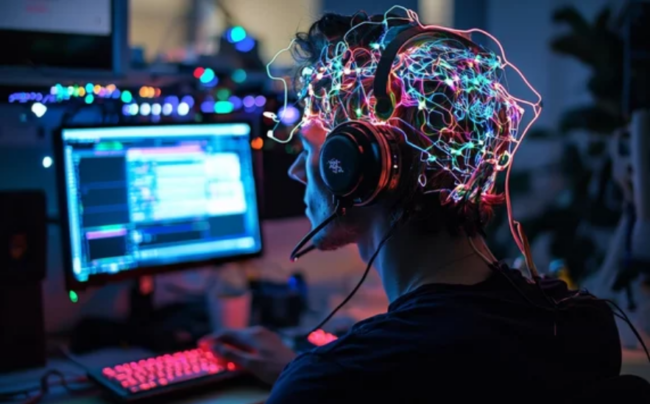
How NeuralSync™ Applies Brainwave Entrainment
NeuralSync™ does not rely on single-frequency tones or static patterns. It uses a multi-dimensional entrainment architecture designed to reflect the complexity of real neural activity.
This includes:
Multiple simultaneous entrainment frequencies
Dynamic patterning to reduce habituation
Left-right channel modulation
Lossless dimensional audio delivery
This approach supports sustained engagement without listener fatigue.
Experiencing Brainwave Entrainment with NeuralSync™
Brainwave entrainment is experiential by nature. The most reliable way to understand its effects is through direct use.
NeuralSync™ Introduction Sessions provide an entry point for experiencing the system without needing to select a specific application.
For a full system overview, see What Is NeuralSync™ Neuro-Frequency Technology.
To experience NeuralSync™ for yourself, download the Introduction Sessions.