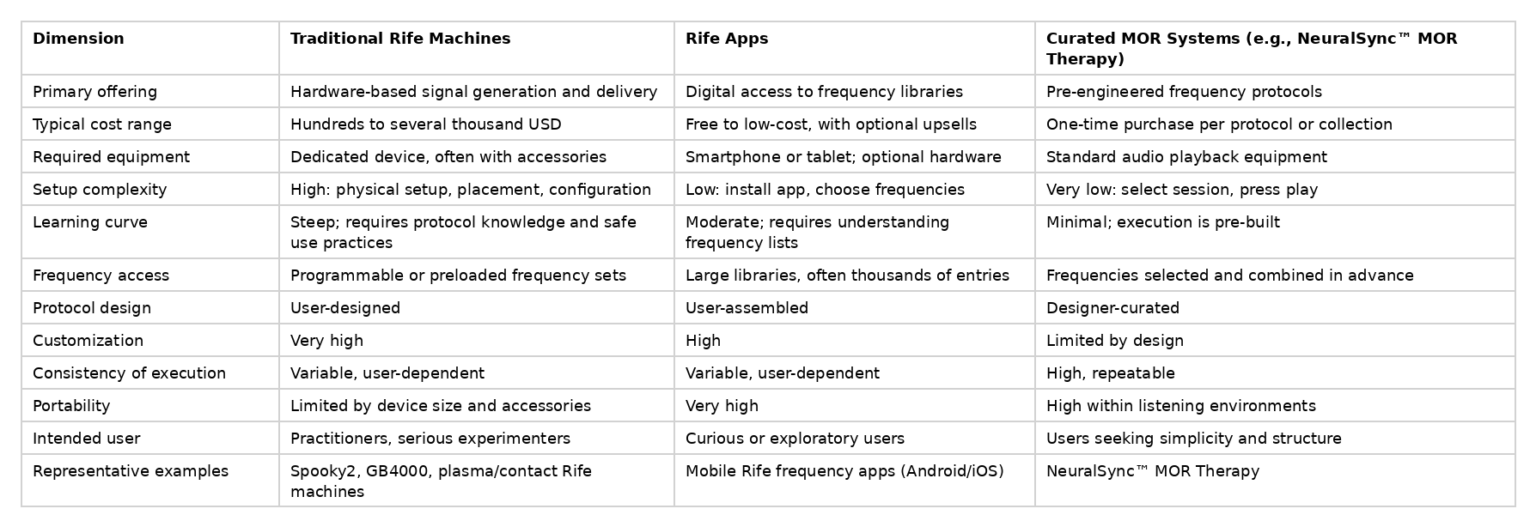
This table illustrates that the core distinction is not access to frequencies, but how much work the user must do to turn access into action.
Cost versus commitment
Cost alone does not determine suitability. Entry-level apps are inexpensive but often demand significant time investment as users learn to navigate large libraries and experiment with combinations. Machines require higher upfront cost but appeal to users who equate investment with seriousness and control.
Curated MOR systems occupy a middle ground financially while minimizing time and cognitive load. Users are not paying for hardware or libraries, but for design decisions made on their behalf.
Learning curve and user confidence
Learning curve strongly affects long-term use. Machines and apps often attract initial interest but see inconsistent application once novelty fades or complexity becomes burdensome. Curated systems trade learning depth for confidence: users know exactly what they are running and can repeat it without modification.
This distinction explains why some users cycle through multiple tools before settling on a format that matches their tolerance for decision-making.
Customization tradeoffs
Customization is frequently marketed as an advantage, but in practice it cuts both ways. High customization allows personalization but also increases the risk of inconsistent or poorly designed use. Limited customization reduces flexibility but increases repeatability and ease of adherence.
Which tradeoff is preferable depends less on technical merit and more on the user’s personality and goals.
What this comparison does and does not imply
This comparison does not assert superiority, efficacy or medical validity for any approach. It clarifies how each option functions operationally and what each demands from the user.
Effectiveness claims, where they exist, are largely anecdotal across all categories. The meaningful distinction for most users is whether they want to operate a system, explore a library or use a finished protocol.
Transition to deeper evaluation
With structural differences established, the next step is to examine each option individually, including where it excels, where it breaks down and what types of users it realistically fits.
The next section begins that process with a focused look at traditional Rife machines, followed by equivalent sections for apps and curated MOR systems.
Traditional Rife Machines — Strengths, Limitations and Fit
Traditional Rife machines represent the most technically explicit and historically anchored way people attempt to engage with Rife frequency concepts today. They are closest in form to the narrative most commonly associated with Rife’s original work: dedicated equipment designed to generate and deliver specific frequencies through controlled, non-audio means.
What defines a traditional Rife machine
In contemporary usage, a “Rife machine” typically refers to a purpose-built electronic device that outputs frequencies through electromagnetic or electrical signals rather than through sound alone. Modern examples of traditional Rife machines include systems such as Spooky2, GB4000, and other contact, PEMF, or plasma-based generators marketed toward advanced users and practitioners. While designs vary, most systems fall into one of several categories:
-
contact-based systems using handholds, pads, or electrodes
-
PEMF-style systems delivering pulsed electromagnetic fields
-
plasma-based systems using radiative tubes
-
hybrid systems combining multiple delivery methods
These machines usually allow users to input frequencies directly, select from preloaded databases, or run sweep programs across ranges of frequencies. The defining characteristic is that the machine itself is the primary delivery mechanism, not an intermediary like a phone or audio player.
Strengths of machine-based approaches
The primary strength of traditional Rife machines lies in control. Users can determine exactly which frequencies are delivered, how long they are applied and in what sequence. For experienced users, this level of control enables detailed experimentation and repeatable protocol design.
Machines also offer a sense of physical legitimacy that some users value. The presence of tangible hardware, visible components and adjustable parameters reinforces the perception that something technical and intentional is taking place. For practitioners or long-term experimenters, this can support disciplined use over time.
Another advantage is compatibility with legacy frequency lists. Many machines are designed specifically to accommodate large, well-known Rife databases, allowing users to replicate or adapt protocols shared within the community.
Limitations and practical drawbacks
The same features that make machines appealing to some users make them impractical for others. Setup is often nontrivial. Users must understand not only frequency selection but also placement, session duration, repetition schedules and safe operating practices.
Learning curves are steep, particularly for newcomers. Without prior experience, users may struggle to distinguish between frequency lists, understand how to combine sets or evaluate conflicting recommendations. As a result, execution quality varies widely between individuals.
Cost is another limiting factor. Even mid-range systems represent a significant investment and higher-end configurations can be prohibitive for casual exploration. Accessories and upgrades further increase expense.
Finally, machine-based approaches demand consistency and attention. They are not passive tools. Missed sessions, incorrect setup, or poorly designed protocols can undermine the user’s confidence or willingness to continue.
Who traditional machines realistically fit
Traditional Rife machines are best suited to users who:
-
want direct, hands-on control over frequency application
-
are willing to invest time learning protocol design
-
value experimentation and customization
-
are comfortable managing technical complexity
They are less well suited to users who want immediate usability, minimal setup or a low cognitive burden. For those users, the machine itself can become a barrier rather than an enabler.
Transition to the next model
Understanding the strengths and limitations of machines clarifies why alternative delivery models emerged. As interest in Rife frequencies expanded beyond technically inclined users, demand grew for ways to explore frequency concepts without hardware complexity.
The next section examines Rife apps, which attempt to preserve access while removing physical and financial barriers and evaluates where that tradeoff succeeds and where it breaks down.
Rife Apps — Accessibility, Tradeoffs and Use Patterns
Rife-related mobile apps—commonly listed under names like “Rife Frequency Generator” or “Rife Therapy Frequencies”—represent the most accessible entry point into Rife-style frequency use today. Rife-related apps represent the most accessible and least capital-intensive way people encounter Rife frequency concepts today. Their emergence reflects a broader trend across wellness and biohacking culture: shifting complex or specialized practices onto general-purpose digital platforms that users already carry with them.
What defines a Rife app
A Rife app is typically a mobile application that presents itself as a frequency generator or frequency library. Most run on smartphones or tablets and deliver frequencies as audio tones through the device’s speaker or connected headphones. Some apps also advertise compatibility with external hardware, positioning the app as both a standalone tool and a gateway to more advanced systems.
Common characteristics include:
-
large, searchable frequency databases
-
labels tying frequencies to conditions, organs, or themes
-
simple playback controls
-
minimal or no guidance on sequencing or duration
The defining feature of this category is that the phone becomes the interface and delivery platform, rather than a dedicated device.
Why apps gained traction
Apps gained traction because they eliminate several barriers at once. They remove the need for specialized hardware, reduce upfront cost and allow immediate experimentation. For users who are curious about frequency-based approaches but hesitant to invest in machines, apps provide a low-risk entry point.
Download numbers and user reviews suggest that many people find value in this accessibility. The ability to explore hundreds or thousands of frequencies on demand aligns well with the self-directed experimentation culture that surrounds Rife concepts.
Apps also benefit from familiarity. Users already understand how to navigate mobile interfaces, which lowers the learning threshold compared to operating standalone machines with proprietary controls.
The central tradeoff: access without structure
The primary limitation of Rife apps is not technological, but structural. Apps excel at providing access, but they rarely provide execution logic.
Most apps present frequencies as discrete items or simple sets. Users are left to decide:
-
which frequencies are relevant
-
how many to combine
-
in what order to run them
-
how long to listen
-
how often to repeat sessions
For experienced users, this flexibility may be acceptable. For many others, it quickly becomes a source of uncertainty. Large libraries can overwhelm rather than empower, particularly when different sources list different frequencies for the same theme.
As a result, app usage often becomes inconsistent. Users may experiment briefly, jump between frequencies or abandon use entirely once the novelty wears off or confusion sets in.
Apps as funnels rather than endpoints
In practice, many Rife apps function less as complete systems and more as funnels. They introduce users to frequency concepts, build familiarity and then encourage progression toward paid upgrades or external hardware.
This funnel model explains why some apps emphasize sheer quantity of frequencies rather than protocol clarity. Abundance signals possibility, even if it does not translate into coherent use.
For some users, this progression makes sense. Apps become a testing ground before committing to machines or more structured approaches. For others, the lack of guidance becomes a stopping point rather than a stepping stone.
Who apps realistically fit
Rife apps are best suited to users who:
-
want to explore frequency concepts with minimal commitment
-
are comfortable experimenting without structured guidance
-
value portability and convenience
-
accept that results, if any, may be inconsistent
They are less well suited to users who want clarity, repeatability or assurance that they are “doing it correctly.” For those users, the freedom apps provide can feel more like a burden than a benefit.
Transition to curated systems
The limitations of apps—particularly the gap between access and execution—directly motivated the development of curated protocol-based systems. These systems attempt to preserve the accessibility of digital delivery while removing the need for users to make technical decisions themselves.
The next section examines curated MOR-based systems, with specific attention to how they address the complexity inherent in frequency selection and protocol design.
Curated MOR-Based Systems — Design Philosophy and Practical Use
Curated MOR-based systems emerged not as an attempt to outperform machines or replace apps, but as a response to a specific and persistent problem: most users do not struggle to find frequencies, they struggle to use them coherently. This category reframes frequency work from an operator-driven activity into a protocol-driven one.
Defining the curated MOR approach
A curated MOR-based system is defined by where decisions are made. Instead of asking the user to select frequencies, determine order or manage timing, those decisions are made in advance by the system designer. The end user interacts with a finished execution rather than a toolkit.
Key characteristics include:
-
pre-selection of all relevant frequencies for a given theme or condition
-
intentional sequencing rather than isolated playback
-
fixed session structure designed to run start-to-finish
-
delivery through standard audio playback rather than hardware controls
The term “curated” is essential here. These systems are not frequency libraries and not generators. They are assembled protocols, built to be used as-is. Unlike partial-curation systems that still rely on external generators or adjustable hardware, fully curated MOR systems eliminate both device operation and protocol assembly.
Multi-faceted frequency construction
One of the core assumptions behind curated MOR systems is that Rife-based work is rarely reducible to a single frequency. In practice, frequency approaches associated with MOR concepts typically involve clusters of related frequencies rather than isolated values.
Curated systems therefore pull from:
-
all commonly cited Rife frequencies associated with a condition or theme
-
overlapping or corroborating frequency sets from multiple sources
-
supportive frequencies traditionally associated with detox, drainage, or regenerative processes
These elements are combined into a single session so that the user is not required to assemble or interpret them. This addresses a common point of failure seen with both machines and apps: incomplete or inconsistent protocol construction.
Why these systems avoid soundscapes
Unlike many audio-based wellness products, curated MOR systems intentionally exclude soundscapes or musical overlays. This is not a stylistic choice but an engineering constraint.
In Rife-informed frequency work, additional audio layers can interfere with frequency clarity and coherence. Soundscapes introduce competing waveforms that may mask, modulate or distort the intended signal. As a result, curated MOR recordings are kept technically clean, prioritizing signal integrity over ambience.
This design choice often surprises users familiar with meditation or relaxation audio, but it reflects a fundamentally different goal: precision over atmosphere.
Practical use experience
From the user’s perspective, a curated MOR system minimizes interaction. Use typically involves:
-
selecting the appropriate session for a given theme
-
playing the session in a suitable listening environment
-
repeating use according to simple, conservative guidelines
There are no settings to adjust, no libraries to browse and no protocols to assemble. This simplicity does not imply certainty of outcome, but it does eliminate variability in execution.
Strengths and limitations
The primary strength of curated MOR systems is consistency. Every user runs the same protocol in the same way, reducing user-introduced variability. This makes them easier to evaluate subjectively over time and easier to integrate into daily routines.
The primary limitation is reduced customization. Users cannot modify frequency order, remove elements or experiment with alternative combinations. For individuals who enjoy tinkering or who want maximum control, this can feel restrictive.
Who curated MOR systems fit
Curated MOR systems are best suited to users who:
-
want to engage with MOR-based frequency work without hardware
-
prefer protocol-first design over experimentation
-
value simplicity, repeatability, and low cognitive load
-
are less interested in operating systems and more interested in consistent use
They are less well suited to users who want to design or manipulate protocols manually.
Transition to brand-specific implementation
While curated MOR systems share common design principles, they are not identical in implementation. Differences arise in how frequencies are sourced, combined, engineered and delivered. Understanding those differences requires examining a specific system rather than the category as a whole.
The next section introduces NeuralSync™ MOR Therapy as a concrete example of how a curated MOR approach is implemented in practice, before returning to broader evaluation and conclusions.
NeuralSync™ MOR Therapy — Implementation and Distinguishing Characteristics
By this point in the landscape, several distinct implementations of Rife-style and MOR-informed systems exist. Hardware manufacturers such as GB4000, Spooky2 and other plasma or contact-based platforms emphasize signal control and device-centric execution. App-based offerings focus on accessibility and breadth, often presenting large frequency libraries with minimal structure. Curated systems represent a smaller but growing category, designed to remove both hardware operation and protocol construction from the user experience.
NeuralSync™ MOR Therapy belongs to this third category. It is not a frequency generator, not a library and not an app-driven interface. It is a protocol-based implementation built around MOR and Rife-derived frequency data, delivered through high-fidelity audio sessions.
Design philosophy
The core design assumption behind NeuralSync™ MOR Therapy is that most users are not seeking tools; they are seeking execution. The system is structured around the idea that effective use of Rife-style frequencies depends less on access to individual numbers and more on how those numbers are combined, sequenced and applied consistently.
Where machines such as Spooky2 or GB4000 provide extensive configurability, and apps provide large, searchable databases, NeuralSync™ removes configurability almost entirely. The design choice is intentional: all technical decisions are made upstream so that user interaction remains minimal.
Frequency sourcing and construction
NeuralSync™ MOR Therapy sessions are built by aggregating all known Rife frequencies associated with a given condition or theme, rather than selecting a single representative value. This reflects how Rife work is commonly discussed in practitioner and community contexts, where multiple frequencies are often run together or in sequence.
In addition to condition-specific frequencies, sessions incorporate supportive frequency components traditionally associated with detoxification, drainage and regenerative processes. These elements are not presented separately or as optional add-ons; they are integrated into the session as part of a single engineered run.
This multi-faceted construction distinguishes curated MOR systems from app-based approaches, where users are often expected to assemble equivalent combinations themselves, and from machines, where protocol completeness depends entirely on operator knowledge.
Delivery method and signal integrity
NeuralSync™ MOR Therapy sessions are delivered as high-fidelity audio files intended for playback through standard audio equipment. Unlike many wellness-oriented audio products, these recordings do not include music, nature sounds or ambient soundscapes.
The exclusion of soundscapes is deliberate. In Rife-informed frequency work, layered audio content can interfere with frequency clarity and coherence by introducing competing waveforms. NeuralSync™ MOR Therapy prioritizes signal integrity over atmosphere, treating the recording as a functional delivery medium rather than an experiential sound design.
This design choice places NeuralSync™ closer in intent to signal-driven systems than to relaxation or meditation audio, even though the delivery mechanism is audio-based.
User experience in practice
From the user’s perspective, NeuralSync™ MOR Therapy is deliberately constrained. There are no menus of frequencies, no settings to adjust, and no protocol decisions to make. Use consists of selecting a session aligned with a specific theme and allowing it to run as designed.
This approach minimizes variability in execution. Every session is identical each time it is played, and every user engages with the same protocol under the same assumptions. While this does not resolve questions about efficacy, it does remove a major source of inconsistency present in both machine- and app-based use.
Comparison to other curated and semi-curated systems
Within the curated space, NeuralSync™ MOR Therapy differs from partial curation models that still require user assembly or external hardware pairing. Some systems present pre-grouped frequencies but still rely on generators, amplifiers or adjustable parameters. NeuralSync™ eliminates those dependencies entirely.
Compared to machines such as GB4000 or Spooky2:
-
NeuralSync™ trades control for simplicity
-
hardware delivery is replaced by audio playback
-
protocol design is fixed rather than user-driven
Compared to apps:
-
NeuralSync™ trades breadth for structure
-
libraries are replaced by finished protocols
-
exploration is replaced by repeatable execution
Practical fit
NeuralSync™ MOR Therapy is best suited to users who:
-
want MOR-informed frequency work without hardware
-
prefer not to assemble or interpret frequency lists
-
value consistency over customization
-
are comfortable with a protocol-first approach
It is less suited to users who want to design their own frequency chains, experiment with delivery mechanisms or modify sessions dynamically.
Transition to evaluation and guidance
With NeuralSync™ MOR Therapy established as a concrete example of a curated MOR system, the remaining task is evaluative rather than descriptive. The next sections examine how users can decide between machines, apps, and curated systems based on goals, tolerance for complexity, and practical constraints.
Choosing Between Machines, Apps and Curated MOR Systems
By this point, the differences between traditional Rife machines, Rife apps and curated MOR-based systems are structural rather than abstract. Each approach reflects a different answer to the same question: how much responsibility should the user carry in translating frequency concepts into actual use.
Choosing between them is therefore less about belief in frequencies and more about fit—fit with temperament, available time, tolerance for uncertainty and willingness to manage complexity.
Decision factors that matter in practice
Although marketing often emphasizes power, precision, or comprehensiveness, real-world choice tends to hinge on a smaller set of practical factors:
-
Tolerance for complexity
Some users enjoy learning systems, adjusting parameters and experimenting with protocols. Others find that same process draining or discouraging.
-
Time and consistency
Frequency-based approaches require repetition. Systems that are difficult to set up or operate consistently are more likely to be abandoned, regardless of theoretical capability.
-
Desire for control versus guidance
Control allows experimentation but requires confidence. Guidance reduces uncertainty but limits flexibility.
-
Comfort with ambiguity
All Rife-related approaches involve uncertainty. Some users are comfortable navigating that ambiguity independently; others prefer clearly defined structures.
These factors matter more than device specifications or library size.
When a traditional machine is the right choice
A traditional Rife machine is the most appropriate choice when the user:
-
wants direct control over frequency selection and delivery
-
is willing to learn protocol design and safe operation
-
values experimentation over convenience
-
accepts that results, if any, depend heavily on execution quality
For these users, complexity is not a drawback but part of the appeal. The machine becomes a tool for ongoing exploration rather than a passive system.
When an app is the right choice
A Rife app is the most appropriate choice when the user:
-
wants to explore frequency concepts with minimal cost
-
values portability and immediate access
-
is comfortable experimenting without structured guidance
-
is unsure whether deeper investment is warranted
Apps work best as exploratory tools. They are often sufficient for curiosity-driven use but may feel incomplete to users seeking clarity or repeatability.
When a curated MOR system is the right choice
A curated MOR-based system is the most appropriate choice when the user:
-
wants to engage with MOR-informed frequency work without hardware
-
prefers finished protocols over libraries or tools
-
values consistency and ease of use
-
does not want to design or manage frequency sequences
This choice prioritizes execution over exploration. The user accepts reduced control in exchange for reduced cognitive load and greater consistency.
Avoiding false comparisons
A common mistake is to treat these options as competing claims about effectiveness. In reality, they represent competing operational models. Each can fail or succeed depending on whether it matches the user’s capabilities and expectations.
A highly configurable machine used inconsistently may be less useful in practice than a simple protocol used regularly. Conversely, a curated system may frustrate a user who wants to adjust and experiment.
Decision summary
The most reliable way to choose is to ask not “which is more powerful,” but:
-
How much complexity am I willing to manage?
-
How consistently will I actually use this?
-
Do I want to operate a system, explore options, or follow a protocol?
Answering those questions honestly tends to point clearly toward one category over the others.
Use Considerations, Expectations, and Safety Posture
Any discussion of Rife frequencies, regardless of delivery method, requires a conservative and realistic framing around use and expectations. The persistence of interest in frequency-based approaches does not eliminate the need for caution, nor does it justify extrapolating beyond what is actually known.
This section addresses how people typically approach use in practice, what expectations are reasonable and where boundaries should be drawn.
Experimental use versus medical treatment
Rife frequencies occupy a space that is best described as experimental and complementary. They are not recognized medical treatments and they are not substitutes for professional diagnosis or care. This distinction matters not only legally, but practically.
Most experienced users approach Rife-based work as:
-
an adjunct to other wellness practices
-
an exploratory tool rather than a definitive solution
-
something to be evaluated subjectively over time
Framing use this way helps prevent unrealistic expectations and reduces the likelihood of misuse driven by urgency or desperation.
Expectations and outcome uncertainty
One of the most common sources of frustration among users is expectation mismatch. Marketing language, testimonials, and community anecdotes often imply clear or rapid outcomes. In practice, experiences vary widely.
Reasonable expectations include:
-
variability between individuals
-
difficulty attributing changes to a single factor
-
gradual rather than immediate effects, if any
Unreasonable expectations include:
Acknowledging uncertainty upfront does not diminish the legitimacy of exploration; it places it on more stable ground.
Frequency complexity and overuse
Another recurring issue is overuse. Because frequency-based approaches are non-pharmaceutical and non-invasive, users sometimes assume more is better. This assumption is not supported even within Rife-oriented communities.
Common pitfalls include:
-
stacking too many protocols simultaneously
-
running sessions too frequently without rest
-
combining multiple delivery systems without coordination
More complexity does not necessarily improve outcomes and can make it harder to evaluate what, if anything, is contributing to perceived changes.
Conservative use principles
Across machines, apps, and curated systems, experienced users tend to converge on similar conservative principles:
-
start with limited exposure
-
allow time between sessions
-
introduce changes gradually
-
track responses rather than chasing outcomes
These principles apply regardless of delivery method and help reduce confusion and discouragement.
Delivery-specific considerations
Each delivery model introduces its own considerations.
For machines:
-
correct placement and intensity matter
-
higher output does not equate to better results
-
misunderstanding settings can lead to inconsistent use
For apps:
-
audio volume and playback quality affect delivery
-
frequent switching between frequencies can undermine consistency
-
lack of structure increases the risk of aimless experimentation
For curated MOR systems:
-
repetition and consistency are central
-
resisting the urge to stack multiple sessions is important
-
simplicity should be preserved rather than overridden
Understanding these differences helps users apply the same conservative mindset appropriately within each model.
Safety posture
A responsible safety posture includes:
-
avoiding claims of diagnosis or cure
-
discontinuing use if adverse reactions occur
-
consulting qualified professionals for medical concerns
-
treating frequency-based work as optional, not essential
This posture does not negate interest or curiosity. It acknowledges limits and reduces harm.
Transition to clarification and misconceptions
Even with careful framing, Rife frequencies remain surrounded by persistent misconceptions and recurring questions. Clarifying these issues helps prevent misinterpretation and supports more informed decision-making.
The next section addresses common questions and misunderstandings that arise across machines, apps and curated MOR systems.
Common Questions and Persistent Misconceptions
Rife frequencies attract sustained interest, but they also generate recurring confusion. Much of this confusion stems from inconsistent terminology, overlapping delivery methods, and the blending of historical claims with modern reinterpretations. Addressing these points directly helps prevent misalignment between expectation and use.
“Is there one correct frequency for each condition?”
No. This is one of the most persistent misconceptions.
In practice, Rife-related frequency work has never operated on a one-frequency-per-condition model. Historical lists, later compilations, and modern databases routinely associate multiple frequencies with the same organism, condition, or physiological theme. These frequencies often originate from different sources, time periods, or theoretical interpretations.
As a result, most contemporary approaches—whether machine-based, app-based, or curated—work with sets or clusters of frequencies rather than single values. The real distinction lies in whether the user assembles those sets manually or uses a system where they are already combined.
“Are audio-based frequencies the same as Rife machines?”
They are not the same in mechanism, but they often overlap in intent.
Traditional Rife machines deliver frequencies through electromagnetic or electrical fields. Audio-based systems deliver frequencies through sound waves reproduced by speakers or headphones. While both are described using the same numerical frequency values, the physical mechanisms differ.
What connects them is not identical delivery, but shared conceptual lineage. Both approaches are attempts to operationalize Rife and MOR ideas using available technology. Treating them as identical or as mutually exclusive oversimplifies how they are actually used.
“If apps and machines exist, why use a curated system?”
This question reflects a misunderstanding of what curated systems are designed to solve.
Apps and machines provide capability. Curated systems provide execution. Users who choose curated systems are not necessarily rejecting control or access; they are choosing to remove decision-making and variability from the process.
For some users, this tradeoff is undesirable. For others, it is precisely what makes consistent use possible.
“Do more frequencies mean better results?”
Not necessarily.
Large frequency libraries can create the impression of completeness, but quantity alone does not address sequencing, interaction or use consistency. Running many frequencies without structure can make it harder to evaluate effects and easier to abandon use altogether.
Across all delivery models, experienced users tend to prioritize coherence and repetition over sheer volume.
“How do systems like Spooky2 or GB4000 compare to audio-based Rife approaches?”
Systems such as Spooky2 and GB4000 are examples of traditional Rife machines that prioritize hardware-based frequency delivery and user control. They allow users to input specific frequencies, design custom protocols, and deliver signals through contact, PEMF-style, or plasma-based methods.
Audio-based Rife approaches use digitally generated frequencies delivered through sound playback rather than electromagnetic hardware. The primary difference is not the frequency numbers themselves, which often overlap, but the delivery mechanism and user responsibility. Machine-based systems emphasize configurability and intensity, while audio-based systems emphasize signal stability, repeatability, and reduced setup variables.
Neither approach resolves questions of efficacy; they represent different operational tradeoffs rather than competing proofs.
“Are Rife apps the same as using a Rife machine like Spooky2?”
No. Rife apps and Rife machines differ significantly in both capability and intent.
Rife apps typically provide access to large frequency libraries delivered as audio tones through a phone or tablet. They are designed for accessibility and experimentation, not for hardware-level signal delivery. Machines such as Spooky2 or GB4000 are dedicated devices built to generate and deliver frequencies through physical interfaces, with greater control but higher complexity.
Apps may introduce users to frequency concepts, but they do not replicate the operational experience or configurability of a machine.
“Are Rife frequencies scientifically proven?”
No, not in the sense of validated medical treatments.
Claims associated with Rife frequencies remain controversial and lack robust clinical evidence. This does not prevent people from experimenting with them, but it does require that claims be treated cautiously and that use be framed as exploratory rather than therapeutic.
Understanding this distinction helps prevent both overconfidence and outright dismissal.
“Why would someone choose NeuralSync™ MOR Therapy instead of a machine like GB4000?”
This choice reflects preference for execution model rather than belief in different frequency theories.
Machines such as GB4000 are designed for users who want to select frequencies manually, build protocols and manage delivery parameters themselves. NeuralSync™ MOR Therapy is designed for users who want MOR-informed frequency work without operating hardware or assembling protocols.
The difference lies in where decisions are made: machines place responsibility on the user, while NeuralSync™ embeds those decisions into a finished protocol delivered as audio.
“Can apps, machines and curated MOR systems be used together?”
They can be, but combining systems increases complexity and reduces clarity.
Using multiple delivery models simultaneously—such as a Rife app alongside a machine like Spooky2, or combining machine use with curated MOR sessions—makes it harder to attribute any perceived effects and increases the likelihood of overuse.
For most users, especially those new to frequency-based work, using one system consistently is more practical than stacking multiple approaches.
“Why do different sources list different frequencies?”
Frequency lists evolved over decades through a combination of historical documents, reinterpretation, anecdotal reporting and cross-influence with other frequency traditions. There is no single authoritative source.
Differences between lists reflect:
-
varying interpretations of Rife’s work
-
later additions by researchers or practitioners
-
differences in measurement units or harmonics
-
reinterpretation across delivery methods
This variability is a defining feature of the landscape, not a flaw introduced by any one system.
“Is it safe to combine multiple systems?”
Combining machines, apps and curated systems without coordination increases complexity and reduces clarity. While some users do combine approaches, doing so makes it harder to attribute any perceived effects and increases the risk of overuse.
For most users, especially newcomers, simplicity and consistency are more useful than stacking multiple tools simultaneously.
“Is a Rife machine more ‘powerful’ than audio-based frequency delivery?”
“Power” is not a precise or universally meaningful term in this context.
Rife machines emphasize delivery modality and adjustable output, which some users associate with power. Audio-based systems emphasize timing accuracy and signal stability. These are different technical characteristics, not measures of superiority.
Whether one feels more “powerful” than the other depends on user expectations, delivery assumptions and how consistently the system is used, not on an agreed-upon standard of effectiveness. Side by side comparison.
Transition to conclusion
Clarifying these questions does not resolve debate, but it does narrow the gap between perception and practice. With definitions, history, delivery methods, and tradeoffs established, the final step is to synthesize this information into a practical summary.
The concluding section distills the guide’s core insights into a concise decision-oriented framework.
Signal Precision and Delivery Fidelity — Audio vs Mechanical Systems
One aspect rarely addressed clearly in Rife-related discussions is signal precision. Conversations often focus on frequency values themselves while overlooking how accurately those frequencies are generated, maintained and delivered. This omission matters because theoretical resonance depends not just on nominal frequency, but on signal stability and coherence.
Frequency value versus frequency integrity
A frequency expressed as a number (for example, 728 Hz) is only meaningful if it is delivered accurately and consistently. In practice, frequency delivery is affected by multiple variables, including:
Two systems outputting the same nominal frequency may differ substantially in how closely that frequency is actually maintained.
Mechanical delivery constraints
Mechanical Rife machines rely on electronic components to generate and transmit frequencies through electromagnetic or electrical fields. While these systems can be powerful, they are subject to several sources of variability:
-
component tolerances that introduce micro-variation
-
signal distortion introduced by electrodes, cables or contact interfaces
-
impedance changes based on placement, skin contact or environmental factors
-
waveform degradation across different output modes
Even small inconsistencies can result in frequency drift or harmonic artifacts. These effects do not invalidate mechanical systems, but they do mean that delivery precision is dependent on setup quality, component condition and user execution.
This dependency is one reason experienced machine users emphasize careful configuration and repeatability.
Audio-based frequency generation and digital precision
By contrast, modern audio-based frequency delivery benefits from digital clocking and sampling precision. When an audio frequency is generated digitally and rendered through high-quality playback systems, several advantages emerge:
-
frequency values are locked to stable digital clocks
-
timing is governed by fixed sample rates
-
repeatability is exact from session to session
-
signal generation is not affected by physical contact variability
In practical terms, this means an audio-based frequency rendered at a specific value will be reproduced with extremely high consistency, provided the playback system itself is stable and unmodified.
This precision is inherent to digital audio architecture rather than dependent on user setup.
Signal purity and interference considerations
Audio-based systems also avoid several interference pathways common in mechanical delivery:
-
no electrode impedance variation
-
no contact pressure inconsistencies
-
no field distortion from placement changes
However, audio delivery introduces its own constraints. Sound reproduction is limited by speaker or headphone response curves and by environmental acoustics. These factors influence how frequencies are perceived and propagated, even if the underlying signal remains digitally precise.
This is why audio-based MOR systems designed for technical frequency delivery avoid musical overlays or soundscapes. Additional audio layers introduce competing waveforms that can modulate or mask the intended signal, reducing coherence.
Precision does not equal efficacy
It is important to separate precision from effectiveness. A signal can be delivered with high fidelity and still have uncertain biological impact. The precision advantage of audio-based delivery does not constitute proof of outcome, but it does address a common misconception: that mechanical systems are inherently more accurate simply because they are physical devices.
In reality, mechanical systems emphasize delivery intensity and configurability, while audio-based systems emphasize signal stability and repeatability. These are different strengths, not interchangeable ones.
Implications for user choice
Understanding signal precision helps explain why some users prefer audio-based MOR systems despite their simplicity. For users who value repeatability, consistency and minimal setup variables, digitally generated audio offers a controlled delivery environment that reduces user-introduced variability.
Conversely, users who prioritize delivery modality, intensity or hands-on control may still prefer mechanical systems, accepting variability in exchange for configurability.
Neither preference implies superiority in outcome; they reflect different priorities in how frequency concepts are operationalized.
Transition to synthesis
With delivery precision clarified alongside historical context, delivery models and use considerations, it becomes possible to synthesize the landscape without oversimplification.
The final section draws these threads together into a practical reference summary.
Conclusion — A Practical Synthesis
Rife frequencies occupy an unusual position in the modern wellness and alternative health landscape. They are neither a singular technology nor a unified methodology, but a constellation of ideas, practices and delivery systems built around a shared historical hypothesis. Understanding them requires separating origin stories from present-day use, frequency values from execution and access from application.
Historically, Rife frequencies trace back to an experimental framework that was never standardized or conclusively validated. Over time, that framework evolved through reinterpretation, technological change and community-driven expansion. What exists today is not a replication of Royal Rife’s original work, but a spectrum of modern attempts to operationalize frequency-based concepts in practical ways.
In contemporary use, people engage with Rife frequencies for reasons that are largely experiential rather than evidentiary. They are drawn by specificity, non-invasive delivery and the promise of agency in addressing complex or persistent concerns. These motivations persist even in the absence of medical consensus, shaping a market that prioritizes usability as much as theory.
The modern landscape has therefore split into three primary delivery paths:
-
Traditional machines, which emphasize control, configurability, and hardware-based delivery at the cost of complexity and learning curve.
-
Apps, which emphasize accessibility and breadth but place the burden of protocol construction on the user.
-
Curated MOR-based systems, which emphasize protocol completeness, consistency, and minimal user intervention by embedding design decisions upstream.
These paths are not competing claims about truth or effectiveness. They are competing answers to the same practical question: how much responsibility should the user assume in translating frequency concepts into use.
Comparative analysis shows that the most consequential differences between systems are operational rather than philosophical. Learning curve, setup friction, consistency and decision load influence real-world use more reliably than theoretical capability. A highly configurable system used inconsistently offers no inherent advantage over a simpler system used regularly and coherently.
Clarifying signal precision further refines this understanding. Audio-based delivery benefits from digital timing accuracy and repeatability, while mechanical systems emphasize delivery modality and intensity but introduce greater variability through setup and physical interfaces. These are distinct strengths, not proof of superiority in outcome.
Across all delivery models, certain patterns recur:
-
frequency work is multi-faceted, not singular
-
protocol design matters more than raw access
-
overuse and excessive complexity undermine clarity
-
expectations must remain conservative and exploratory
The absence of definitive clinical validation does not render exploration meaningless, but it does demand intellectual honesty. Rife frequencies are best understood as experimental tools within a broader landscape of wellness practices, not as replacements for diagnosis or treatment.
For readers seeking orientation rather than persuasion, the most reliable takeaway is this:
the “best” Rife frequency approach is the one that aligns with how a person actually engages with systems—how much complexity they tolerate, how consistently they follow protocols and how they navigate uncertainty.
Seen this way, machines, apps and curated MOR systems are not rivals. They are different interfaces to the same underlying curiosity about frequency, resonance and biological interaction. Understanding their distinctions allows informed choice without exaggeration, dismissal or misplaced certainty.
That, ultimately, is the purpose of a definitive guide: not to settle debate, but to make the landscape intelligible.