
Comparing Rife Frequency Systems: NeuralSync™ vs Spooky2 vs Qi Coil
Rife frequencies are frequently treated as if they belong to a single, uniform category. In practice, the Rife landscape is fragmented, shaped by very different ideas about how frequencies should be generated, delivered and organized into sessions. This makes system-to-system comparisons confusing, especially for people new to Rife or MOR-based approaches.
This page offers a focused comparison of three commonly discussed options: NeuralSync™, Spooky2, and Qi Coil. Rather than promoting one “best” system, it explains how each is designed, how it is typically used and what tradeoffs are involved, so you can choose an approach that matches your goals, lifestyle and technical comfort level.
Why Rife Comparisons Often Mislead
Many Rife comparisons fixate on frequency numbers or hardware specifications while ignoring the larger delivery architecture. Two systems can publish the same frequency values yet feel very different in use because of factors such as:
Whether frequencies are delivered through dedicated hardware or audio recordings.
How many frequencies are combined in a single session and how they are structured.
Whether sessions are sequential scripts, single-target runs or aggregated sets.
How much technical setup, learning, and maintenance the user must handle.
Because of these variables, declaring one system “better” in absolute terms misses the point. What matters more is how well a system fits your daily routine, your tolerance for complexity and your ability to use it consistently over time.
Hardware vs Audio-Based Rife Delivery
Historically, Rife frequencies have been delivered almost exclusively via physical devices. Classic and modern hardware systems—such as GB4000, TrueRife, JWLABS and Atelier Robin devices—use contact, plasma, or resonant-field outputs driven by electronic generators. These platforms emphasize precision and user control but require equipment, calibration and hands-on frequency selection.
Newer platforms extend this hardware model in different directions:
Spooky2 combines computer software, scripted programs and multiple accessories to offer contact, remote, PEMF and plasma-based frequency delivery within a single ecosystem.
Qi Coil converts selected harmonic audio programs into pulsed electromagnetic fields through proprietary coils, emphasizing resonant-field exposure over direct contact.
NeuralSync™ breaks from device-centric delivery by providing digitally generated Rife/MOR sessions as pure audio, using curated frequency sets that can be played on standard listening devices without any physical generator.
These differing delivery models are central to how each system feels in day-to-day use and how easily it fits into an existing lifestyle.
Core Comparison Overview
The table highlights the main structural differences between NeuralSync™, Spooky2 and Qi Coil at a glance. The sections below expand on what those differences actually mean in practice for setup, learning curve and long-term
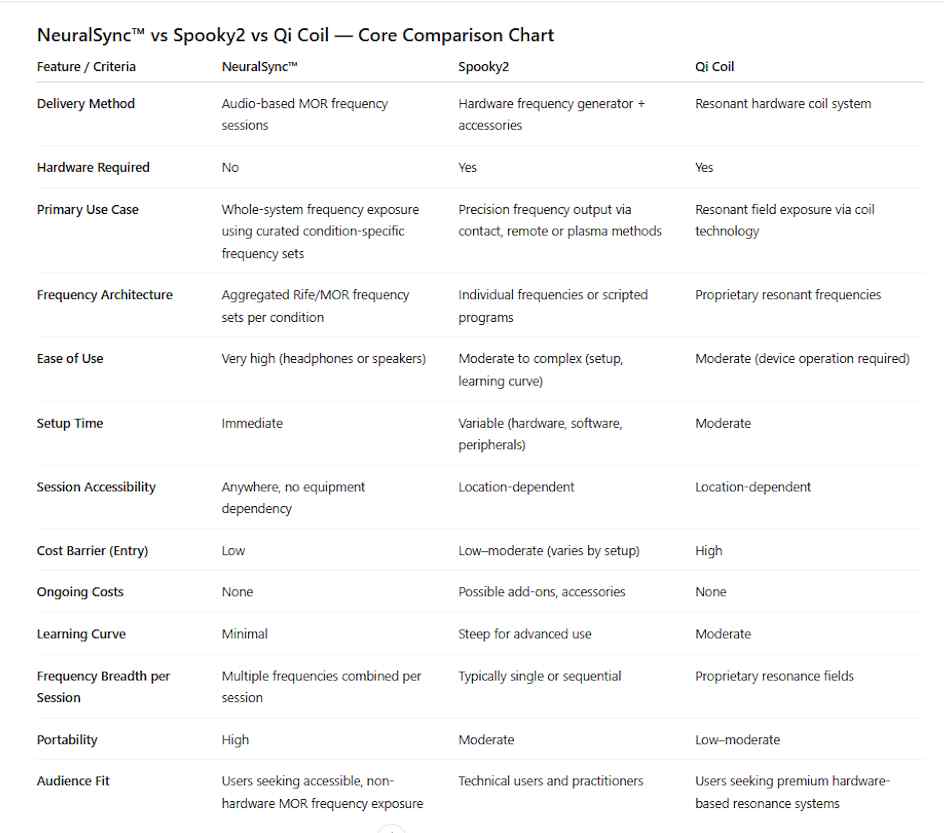
How each system approaches Rife and MOR frequencies
NeuralSync™
NeuralSync™ is built on the premise that MOR and Rife-informed frequencies can be delivered digitally without any dependence on dedicated hardware. Instead of running single frequencies or complex device scripts, NeuralSync™ recordings embed multiple Rife-derived frequencies associated with a specific goal into a single, structured audio session.
Because the signal is generated digitally, each frequency is defined mathematically, phase-locked and stabilized so it can be reproduced with high consistency from session to session. This removes common barriers in device-based systems: there is no equipment to maintain, no generator to calibrate and no need to manually program scripts. Sessions can be played in a wide range of environments—at home, during rest or alongside other routine activities—making regular use more realistic for people who value simplicity and consistency over hands-on configuration.
NeuralSync™ is typically chosen by users who want an accessible, portable way to work with Rife-informed frequency sets without owning hardware or learning technical workflows. The system reflects a design philosophy that prioritizes ease of use, routine integration and repeatable digital precision rather than maximal user programmability.
Spooky2
Spooky2 is one of the most feature-rich and technically flexible hardware-based Rife ecosystems currently available. It pairs frequency generators with comprehensive PC software, scripting capabilities, and optional accessories to support multiple delivery methods, including contact, remote, PEMF and plasma-based outputs.
This architecture gives users very fine-grained control over individual frequencies, waveforms and session design, and it includes large libraries of prebuilt programs. However, the same flexibility introduces complexity: effective use usually requires time spent learning the software, understanding scripts and managing the physical setup of generators, cables, and accessories.
Spooky2 is frequently grouped with systems like GB4000 and JWLABS because it appeals to technically inclined users and practitioners who want deep customization and are comfortable working directly with frequency programming. For these users, the extensive control is a major strength; for others, the learning curve can become a barrier to consistent, long-term use.
Qi Coil
Qi Coil focuses on resonant-field delivery through purpose-built electromagnetic coils. The system converts specially prepared audio or frequency programs into pulsed electromagnetic fields, creating a localized energetic field around the coil rather than requiring direct contact or electrodes.
Qi Coil systems are typically positioned at a higher price point and marketed toward users who prefer a tangible, self-contained hardware experience without dealing with programmable generators or scripting software. The interface is simpler than a full generator ecosystem, but sessions remain tied to the physical coil and console, which means use is anchored to specific locations and setups.
Qi Coil is often mentioned alongside other resonance- and field-based systems, such as Resonant Light and similar devices, which prioritize field interaction as the primary mode of frequency delivery rather than direct contact or pure audio.
Other Rife Systems You May Encounter
While this page focuses on NeuralSync™, Spooky2, and Qi Coil, anyone researching Rife frequencies will encounter a wide range of additional devices and generators, including:
GB4000 and related frequency generators
TrueRife systems
JWLABS frequency generators
Atelier Robin devices
Resonant Light systems
Various zapper-style and portable frequency units
These solutions vary widely in engineering approach, user interface and target audience, yet all rely on physical hardware for frequency output. Mentioning them here provides context for where NeuralSync™, Spooky2, and Qi Coil sit within the broader hardware-dominated Rife ecosystem.
Choosing the Right Approach
There is no single universally “correct” Rife system. The most appropriate choice depends on which tradeoffs matter most to you:
Ease of use and accessibility: Minimal setup, no hardware ownership and straightforward daily integration (for example, audio-based sessions).
Technical control and customization: Detailed control over frequencies, waveforms, scripts and multiple delivery modes, with a higher learning curve.
Hardware-based resonance and devices: Preference for hands-on equipment, electromagnetic field exposure and a more tactile experience.
Understanding these priorities helps explain why multiple approaches coexist and why meaningful comparisons focus on fit, not on declaring one system universally superior. Each of the three systems here reflects a different answer to the same core question: how should Rife and MOR frequencies be structured, delivered and integrated into real-world use over time?